THE UX OF FINAL MAJOR PROJECT | BLOG 01
FMP Proposal SetUp
14/07/21 – 25/11/21 (about 3 months - excluding summer holidays)


 Design Brief: Exploration of de-tokenisation / mitigating monetary aspect of blockchain.
Project Member: Yiwei(David) Han, Sue Heeyeon An.

Design Phase
Teaming Up & First 3 Topics
Sue and I agreed that we had collaborated well together on previous projects (UX of Memory, Loneliness Collaboration, Brixton Pound & Blockchain Collaboration), so we decided to continue working with each other in our final major project. After the first group discussion and brainstorming, we selected three topics that interest us most:
- Blockchain: explore its limitation and untapped areas.
- Prehension: explore the relatedness between non-human entities, artistic work.
- Autonomous driving: materialise the relationship autonomous vehicle and gestural language who riding motercycles/ cycles / horse / bus or even pedestrians on the road.
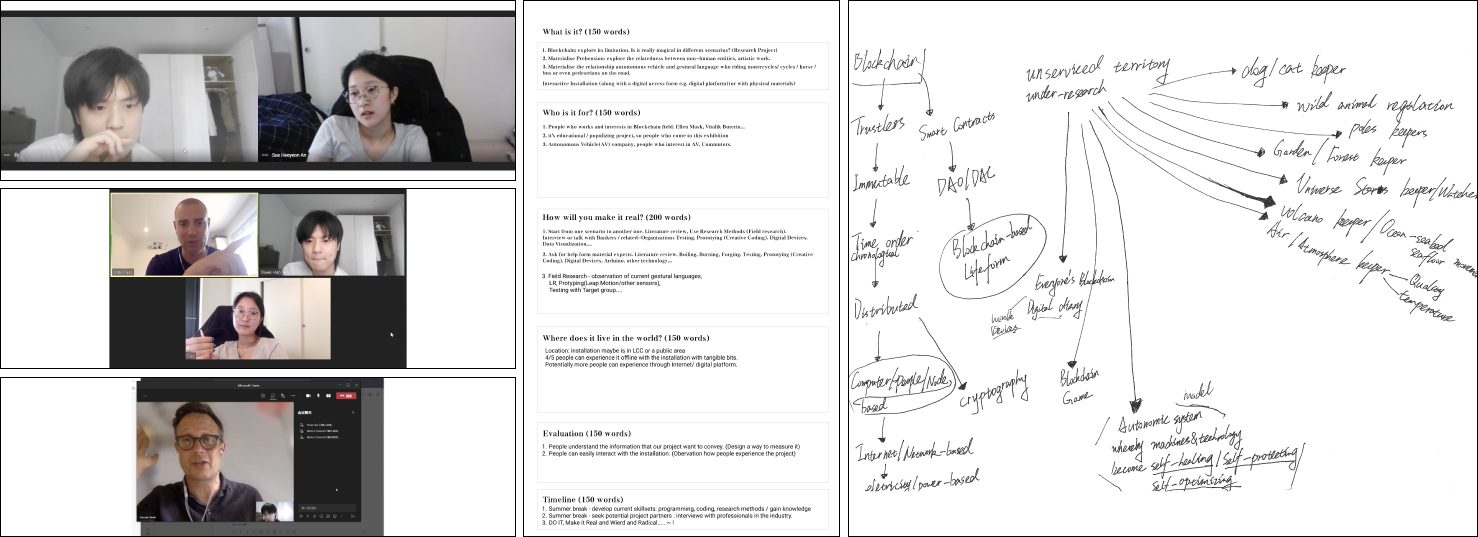
Meeting & tutorial with teammate and tutors; Our initial 3 ideas; Brainstorming sketch about Blockchain (Courtesy of David).
The advice we received from both tutors was to think about what kind of job you want to do in January 2022 and how this project can help you get into that. This means that the project will need to demonstrate the appropriate skills, such as the ability to research, prototype or to show that you are a crtital or conceptual thinker. In addition to this, they raised us thought-provoking & heuristic questions based on each of the three topics. For example,
- For Blockchain Topic: Can we find some interesting structure in the notion of a blockchain?
- For Prehension Topic: Which non-human entities and material relationships do we want to explore and why it's worthy or important to explore?
- For Automatic driving Topic: "I'm not interested in this" - John Fass. I second.
In the end we found that the blockchain topic would have more scope to explore and possibilities to present other unique capabilities. And, since our last project was also blockchain-related, it was more advantageous and smart to continue exploring it. Therefore, Blockchain is our final decision.
Initial Background Research - Blockchain
Our initial background research focuses on three aspects of blockchain: the share of blockchain technology used in the market; the share of different blockchain consensus mechanisms and usage; and the ecological impact of blockchain technology. The following are some of the findings: 1. blockchain technology is currently mainly used in the financial sector, especially in cryptocurrencies, of which there are currently thousands of different kinds, but other potential application scenarios for the technology are yet to be discovered. 2. consensus mechanisms, PoW and PoS are still dominant, which means that most of them rely on monetary values such as tokens & incentives. 3. The current mainstream consensus mechanisms (PoW, PoS) have huge resource wastage and pollution problems.

Initial research about 1. Current market share of blockchain applications; 2. Types of consensus mechanisms and share of use; 3. Impact of blockchain (Made by Group).
Vicious chain reaction: On top of that, we found a correlation between the three, as the underlying mechanism of most cryptocurrencies is PoW or PoS, two consensus mechanisms that inevitably lead to energy consumption. And since most of the application markets are cryptocurrencies, their incentives will attract a large number of ‘gold diggers'(miners) to participant in and compete with each other, which will further accelerate energy consumption and waste.
Two Initial ideas
Based on these findings and insights and combined with a sustainability perspective, we would wonder if it is possible to decouple incentives in the blockchain from money? Can we reveal the current problems with the blockchain in an experiential way? So we came up with 2 ideas from both problem solving and problem finding perspectives:
1. Design a small demo of a blockchain with a different consensus mechanism which is de-tokenisation or none-monetary aspect and people can interact with or experience it.
2. Drawing on the concepts of Crawford's Anatomy of an AI System, we also wanted to create an anatomy map of blockchain system, mainly revealing the hidden environmental consequences of the use of this technology.

Initial Design Brief.
Pecha Kucha - Presentation
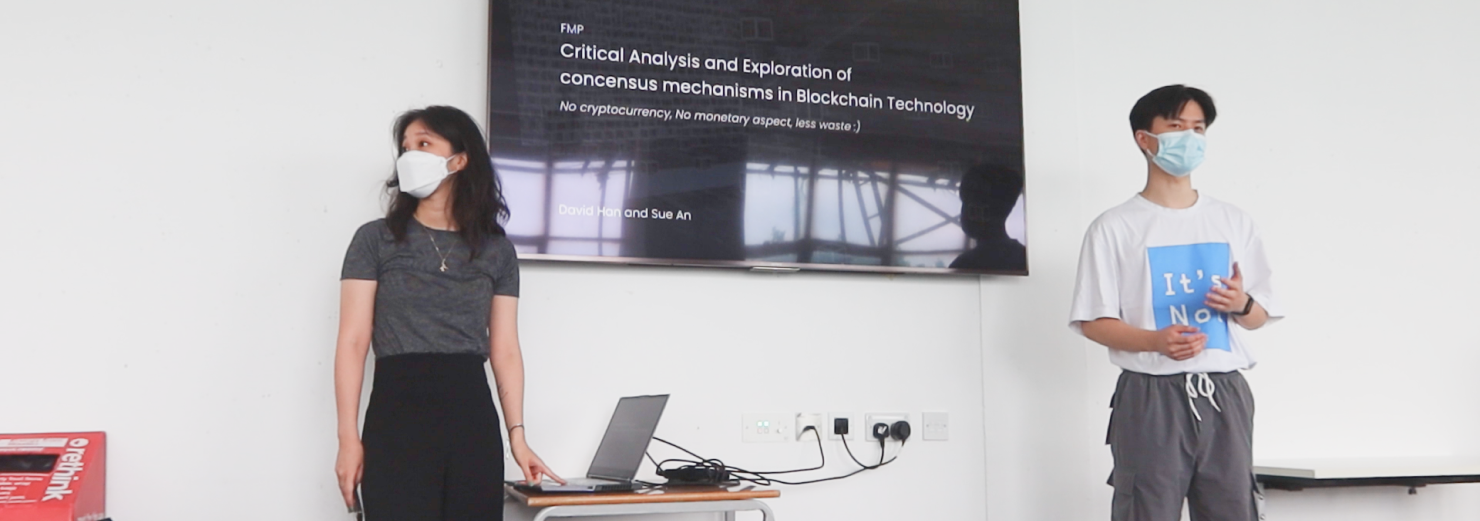
Picture of the presentation (Courtesy of David).
After just a few minutes of Pecha Kucha's presentation, we received a lot of feedback from the tutors and students. Firstly they were interested in our idea of de-tokenisation, but also raised many concerns. For example, how do we design a consensus mechanism that is invisible and difficult? How do we make it real? Are we trying to raise awareness or do we want people to use the new blockchain we created? Who is our target group (human)? Is this a speculative design? As it is a difficult concept, how we can make this topic more accessible? These are all great questions, we will answer them at the different phases of the project.
Reference
Crawford, K. and Joler, V. (2018). Anatomy of an AI System. [online] Anatomy of an AI System. Available at: https://anatomyof.ai/ [Accessed 23 Nov. 2021].
Digiconomist (2021). Ethereum Energy Consumption Index (beta). [online] Digiconomist. Available at: https://digiconomist.net/ethereum-energy-consumption [Accessed 12 Jul. 2021].
Eswaran, S. (2020). Consensus Algorithms | Blockchain Technology Fundamentals. [online] Witspry Witscad. Available at: https://witscad.com/course/blockchain-fundamentals/chapter/consensus-algorithms [Accessed 12 Jul. 2021].
Goodkind, A. et al. (2020) ‘Cryptodamages: Monetary value estimates of the air pollution and human health impacts of cryptocurrency mining’. Energy Research & Social Science. 59.
Grand View Research (2021). Blockchain Technology Market Size, Share | Industry Report, 2019-2025. [online] www.grandviewresearch.com. Available at: https://www.grandviewresearch.com/industry-analysis/blockchain-technology-market [Accessed 12 Jul. 2021].
THE UNCANNY VALLEY (2021). Episode V. toward a New Ecology of Crypto Art: a Hybrid Manifesto |. [online] Flash Art. Available at: https://flash---art.com/2021/02/episode-v-towards-a-new-ecology-of-crypto-art/ [Accessed 12 Jul. 2021].