THE UX OF FINAL MAJOR PROJECT | BLOG 02
Primary Research & Analysis
14/07/21 – 25/11/21 (about 3 months - excluding summer holidays)


 Design Brief: Exploration of de-tokenisation / mitigating monetary aspect of blockchain.
Project Member: Yiwei(David) Han, Sue Heeyeon An.

Design Phase
Can we materialize the blockchain in a way that is unconnected to money or monetary incentives? Before thinking about this question, I think we need to understand why the current mainstream blockchain needs monetary incentives. In this blog, I will showcase our primary research, which includes: watching interviews with blockchain experts; a brief synthesis of mainstream blockchain; and a moodboard of blockchain applications in non-financial and non-cryptocurrency space. We want to clarify two questions through our research: 1. Why do mainstream blockchains need monetary incentives? 2. What else can blockchains be used to record but monetary transactions?
New Type of 'Expert Interviews'
We wanted to interview the builders of mainstream blockchains (e.g. Bitcoin blockchain, Ethereum, Algorand, etc.) to find out Why did they design their incentives the way they did? What is their paradigm/reasons behind it? However, these people were almost impossible to contact, so we came up with a new way of "interviewing" them —— watching their interview videos. We want to find some answers of these questions:
- Why those blockchains need ‘monetary incentives’?
- Why those blockchains need token/cryptocurrency?
- What can we learn from them?
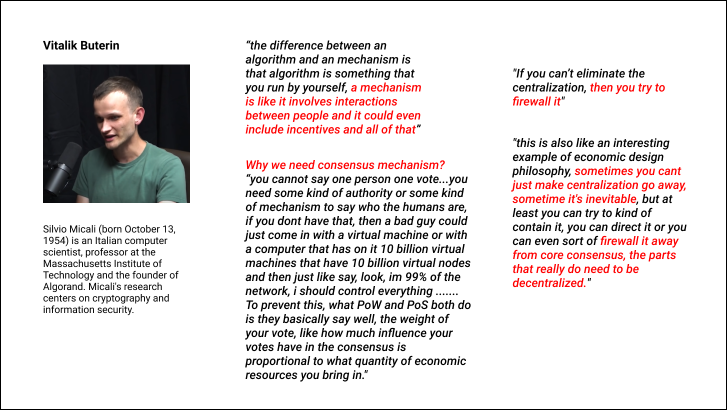
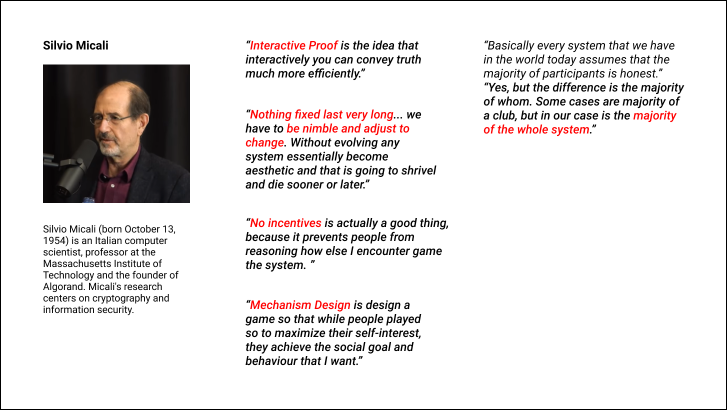
My interview video watching takeaways (Courtesy of David).
I mainly watched interview videos with two blockchain founders (Ethereum founder - Vitalik Buterin; Algorand founder - Silvio Micali) and recorded their insightful views, Sue watched an interview video with Sergey Nazarov, the founder of Chainlink. While we gained interesting insights and perspectives beyond the research questions, we did not find direct answers as to why incentives were needed in their blockchain system. But borrowing Meadow's concept of systemic leverage points, I was able to slowly appreciate this answer.
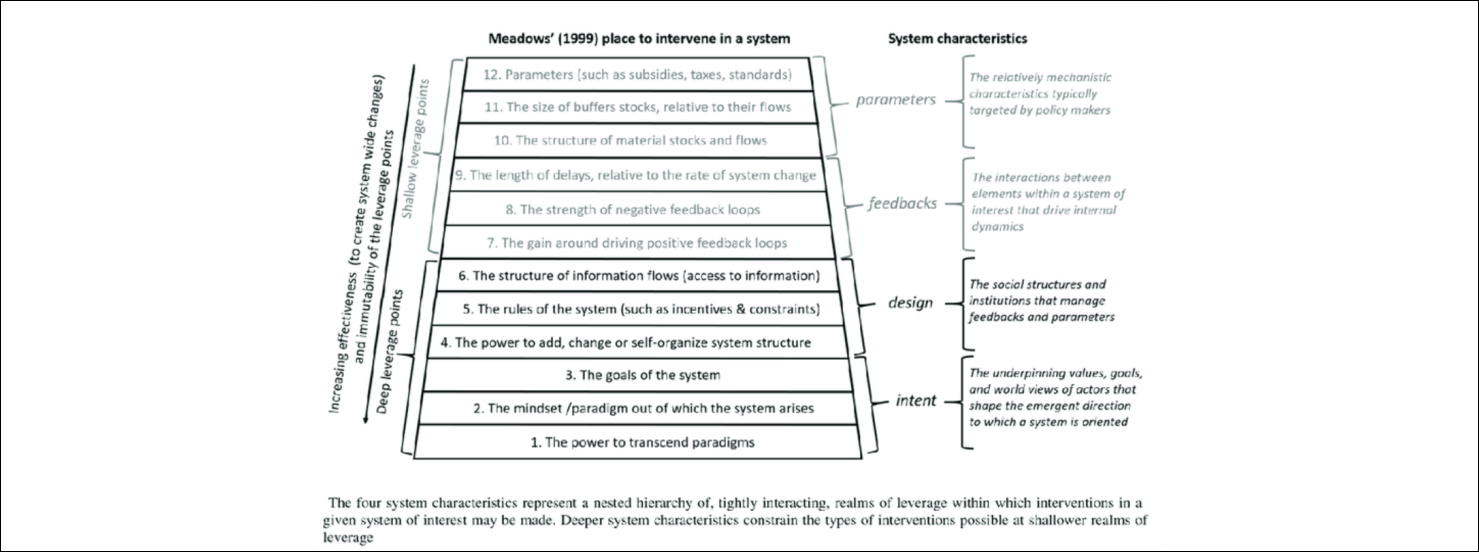
Leverage points to four system characteristics (Kirst and Lang, 2019).
Why mainstream blockchains need monetary incentives? What I can understand now is that monetary incentives are the necessary rules to be able to make their blockchain system work properly, and consensus mechanisms are the necessary constraints to ensure the qualities of the blockchain. This is the equivalent of the "fifth layer - the rules of the system" in Meadows' system leverage point. If we want to change the monetary incentives, we need to think about what else could have the same effect (attracting actors to work within the blockchain system) other than money.
“Mechanism Design is design a game so that while people played so to maximize their self-interest, they achieve the social goal and behaviour that I want.” - Silvio Micali
This will be a very challenging behavioural design problem, as different people have different motivations. This requires us to understand exactly who our target audiences are and what their motivations are. Secondly, if we drop the incentives, the blockchain system risks losing its robustness because there may be no one willing to maintain it without compensation.
Mainstream Blockchain Comparison Synthesis
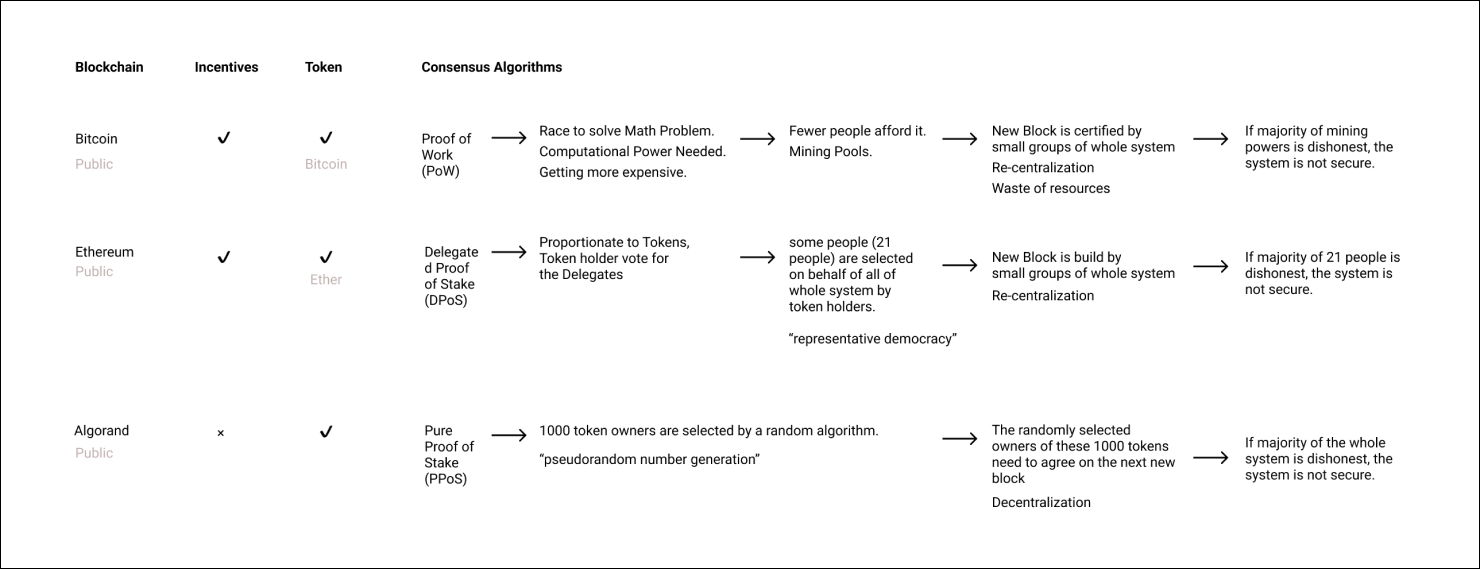
Brief mainstream Blockchain Synthesis (Made by Group).
I also suggested to do a synthesis of the features between the Bitcoin, Ethereum, and Algorand, in terms of incentives, consensus mechanisms, and so on. We found that in regards to consensus mechanisms, both the Bitcoin blockchain and Ethereum have the potential to evolve into a recentralized situation. This mainly stems from the inadequate negative feedback loops in the system, coupled with the fact that the rules of the blockchain are all fixed, even if decentralisation is detected, there is no way for the system to adjust or reorganise itself internally. We also found that they both have tokens, but Algorand has no incentive mechanism due to its purely random nature.
“Sometimes you can't just make centralization go away, sometime it's inevitable, but at least you can try to contain it, you can direct it or you can even sort of firewall it away from core consensus, the parts that really do need to be decentralized.” - Vitalik Buterin
Moodboard of Blockchain in New Areas
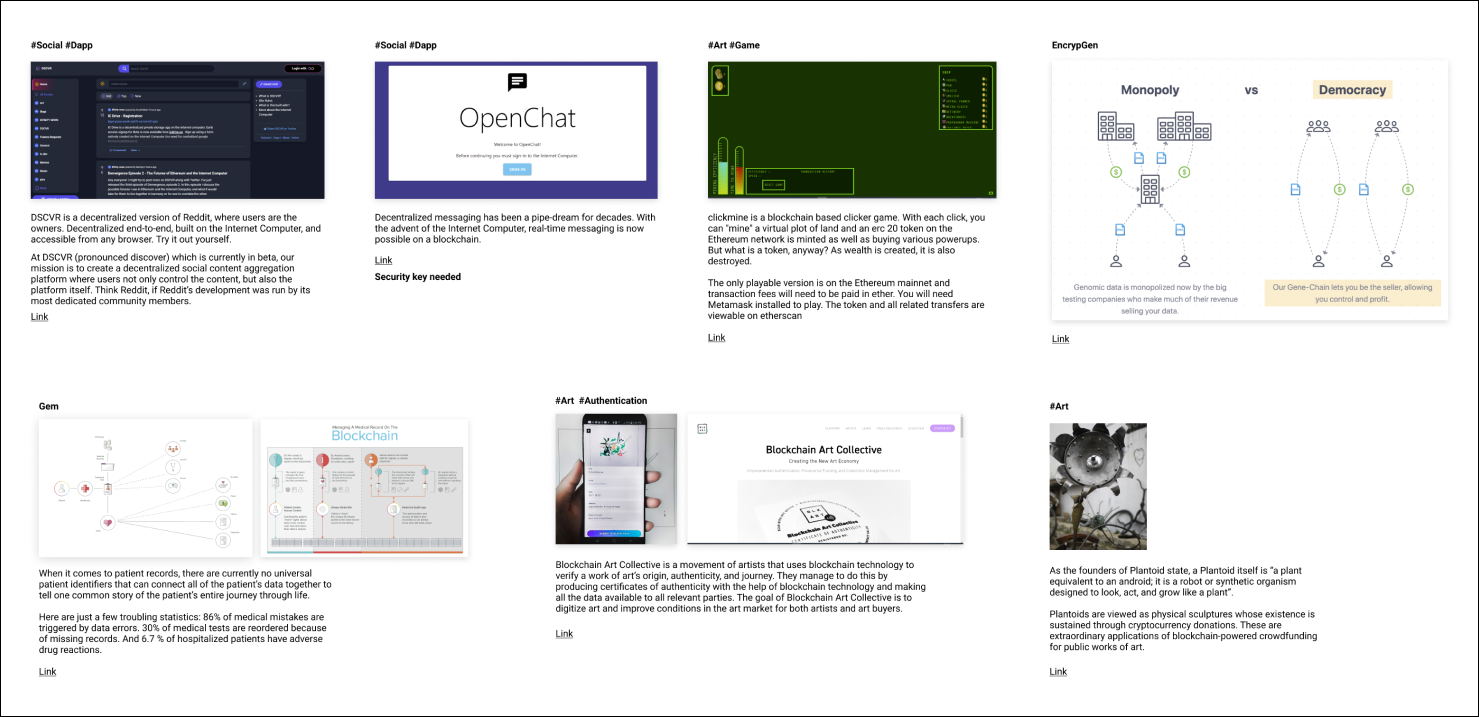
Moodboard of Blockchain in none-cryptocurrency market (Courtesy of David).
What else can blockchains be used to record? We have found applications using blockchain technology in many other areas, none of which have anything to do with money. For example, blockchain is used to record information and sources of artworks; to record people's DNA; to act as a decentralised chat platform; and even games. Although we understand that there are endless opportunities for blockchain in many other areas, using blockchain as a tool is not what we were originally designed for. What we want is to use our design to identify the consequences (Recentralization, Energy Waste, Environmental Impact) from blockchain.
Reflection
This initial research did help us understand blockchain a little further, for example, that consensus mechanisms are indeed essential to blockchain, but not necessarily monetary incentives (incentives could perhaps be other things such as reputation, grade, etc.). We also learned that consensus mechanisms are designed as a means of maintaining blockchain system, but that there is not currently a particularly perfect means of doing so (PoW comes at the cost of consuming energy, PoW & PoS both risk recentralisation).
But this research method is also very limiting, especially the first one of watching interview videos, which, due to the lack of interactivity, leads us to potentially waste a lot of time watching irrelevant topics, a method that can add breadth rather than depth to the topic. However, sometimes those unrelated knowledge has an unexpectedly stimulating and inspiring effect on the design process.
In terms of research decision making, rather than responding directly to feedback from last week's presentation (e.g. thinking about target audience, etc.), we chose to broaden our background research. Nevertheless, as Sue had her own work in the meantime, I was mainly responsible for most of the research, which led to the group meetings becoming one-sided research presentations rather than more interactive summaries and in-depth discussions that can really answer the questions. This was also the main reason for the slow progress of the project in the early stages.
Reference
Blockchain Art Collective (2021). How it Works. [online] Blockchain Art Collective. Available at: https://blockchainartcollective.com/howitworks [Accessed 12 Jul. 2021].
Clickmine (2021). ClickMine. [online] clickmine.click. Available at: https://clickmine.click/ [Accessed 12 Jul. 2021].
EncrypGen (2021). EncrypGen. [online] encrypgen.com. Available at: https://encrypgen.com/ [Accessed 12 Jul. 2021].
Fridman, L. (2021). Silvio Micali: Cryptocurrency, Blockchain, Algorand, Bitcoin & Ethereum | Lex Fridman Podcast #168. [online] www.youtube.com. Available at: https://www.youtube.com/watch?v=zNdhgOk4-fE&t=1514s [Accessed 12 Jul. 2021].
Fridman, L. (2021). Vitalik Buterin: Ethereum 2.0 | Lex Fridman Podcast #188. [online] www.youtube.com. Available at: https://www.youtube.com/watch?v=XW0QZmtbjvs [Accessed 12 Jul. 2021].
Gemology Blog (2017). Gemology. [online] Gem. Available at: https://enterprise.gem.co/gemology/ [Accessed 12 Jul. 2021].
Kirst, E. and Lang, D. (2019). Perspectives on Comprehensive Sustainability-Orientation in Municipalities: Structuring Existing Approaches. Sustainability, 11(4), p.1040.