THE UX OF FINAL MAJOR PROJECT | BLOG 05
Design Consideration & Literature Review
14/07/21 – 25/11/21 (about 3 months - excluding summer holidays)


 Design Brief: To be explored and researched...
Project Member: Yiwei(David) Han, Sue Heeyeon An.

Design Phase
Before continuing to refine and develop our revealing complexity of blockchain ideas, we reconsider the starting point of our design, we mainly considered two questions: 1. in what form to express or demonstrate our concept; 2. why we are doing this design?
Design Consideration - How to Storytell Blockchain?
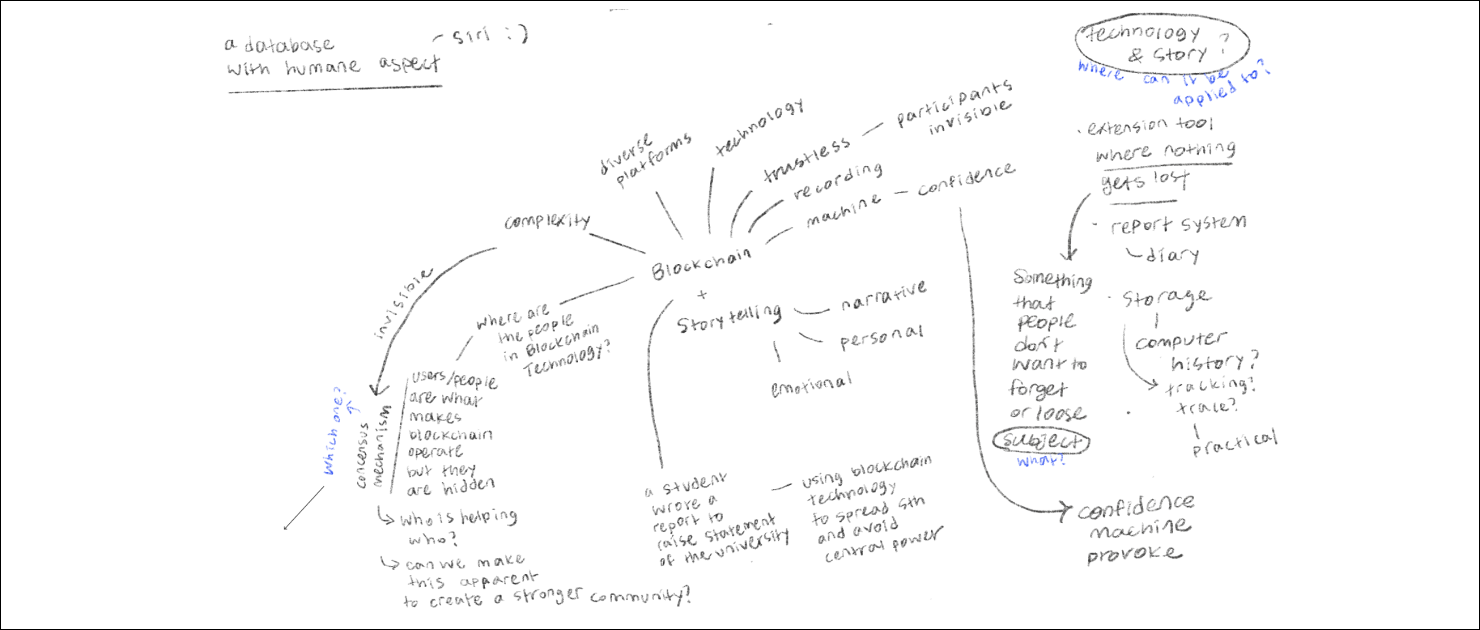
Brainstorming about Blockchain + Storytelling (Made by Sue).
Last week Eva proposed to us an interesting combination of concepts: Blockchain + Meta-narrative, and I found that this actually goes in two directions: the first, where we tell the story of Blockchain itself, which in our context is about the environmental impact of the blockchain and the invisible inner workings of the system. The second, is to use Blockchain as a tool to tell or document other stories, such as the history of an event. We decided to go for the first one.
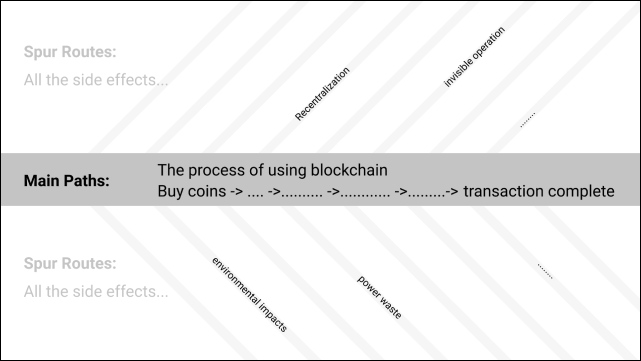
Method 1: Storytell Blockchain's Story (Made by David).
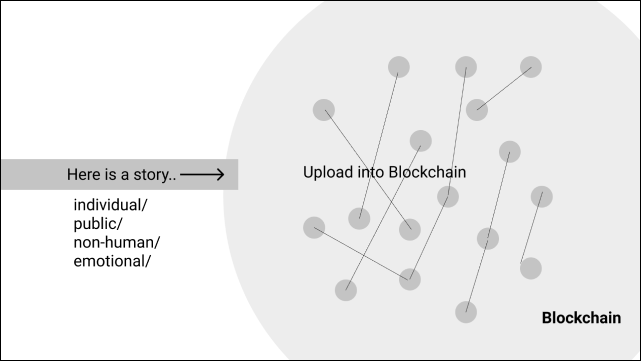
Method 2: Use Blockchain to storytell other story (Made by David).
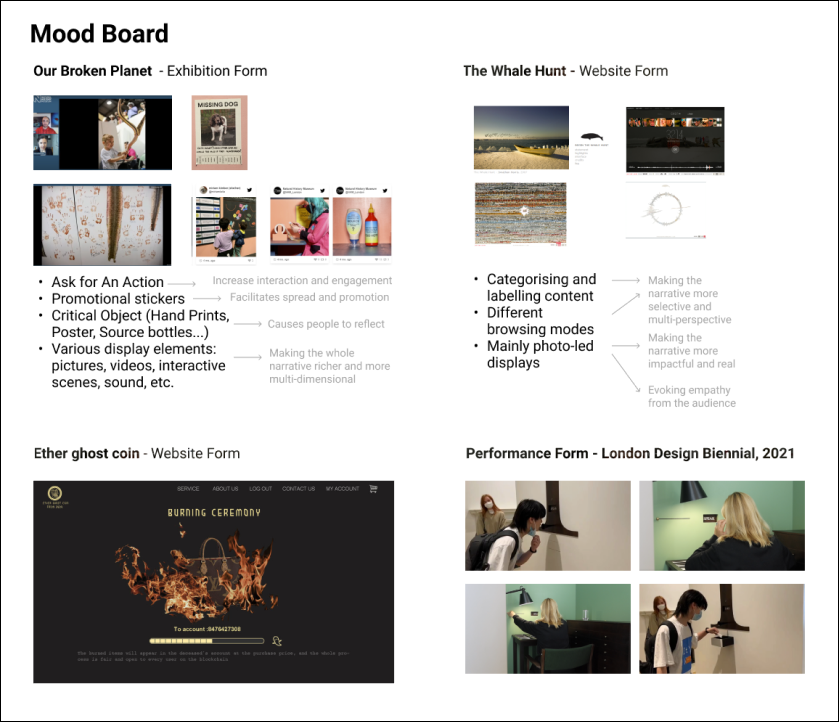
Mood Board about Storytelling Experience Forms (Made by David).
So we started discussing what form of design to use to express our design ideas. We considered three main genres (web design, performance, physical model), but we weren't sure which one would be best to use. So I collected some work from all three types to make a mood board, mainly to summarise what we could learn from each type and use it as a reference for decision making.
Literature Review - Why We Do This Design?
Thinking about how to answer the tricky question of WHY. Very often, designers start their designs based on a real problem, but in our case, blockchain users don't affect their using experience even if they can't see how this complex system operates or impacts. Just like the internet, everyone uses it, but no one cares how it actually works or what its mechanisms are like (or very few people do). As a result, for designers, our design brief was missing a reason or proper context.
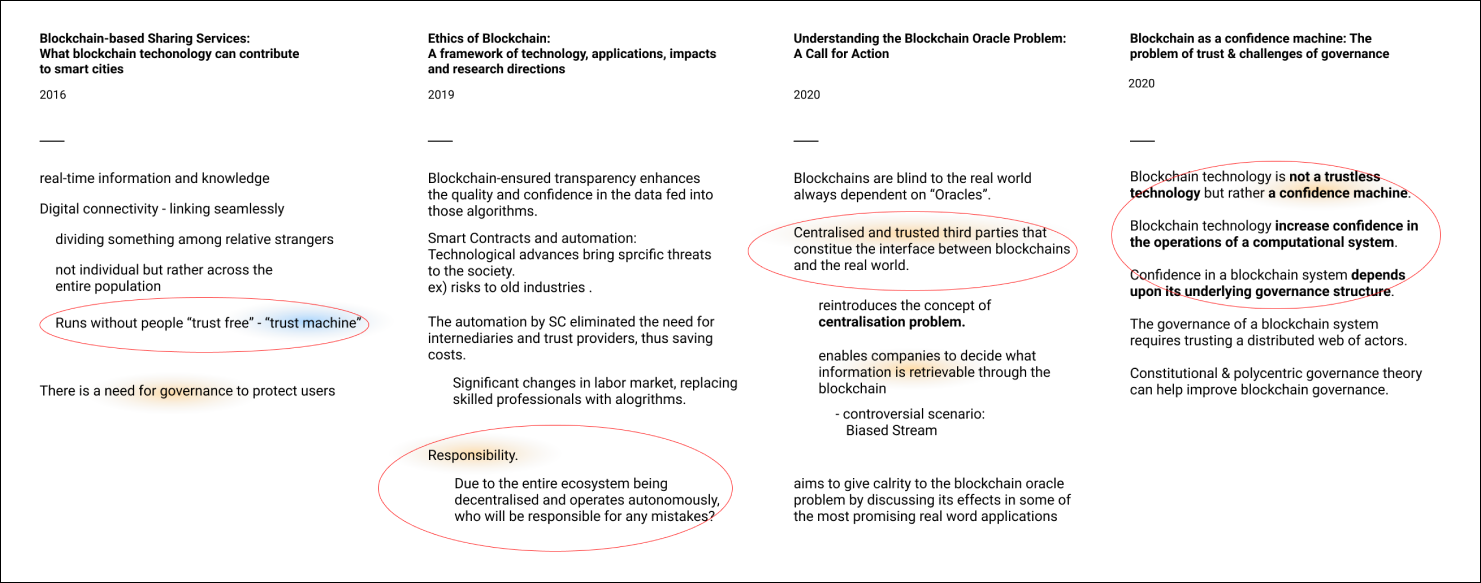
Discussion in the literature review on whether blockchain is trustworthy (Made by Group).
In order to be able to answer this question, we decided to use the literature review method to explore a proper rationale. In the papers that Sue and I read together, we found that the one thing they all had in common was that they discussed the topic of 'trust' in blockchain. we have compiled three views:
- The first is that blockchain is a trustworthy technology because of its specific technical mechanisms and rules.
- The second view is that it is not entirely a 100% trustworthy technology because it operates with a variety of actors involved (e.g. NFT sellers, miners, administrators, etc.) and there is no guarantee that all of these actors are trustworthy.
- The third believes that further research and investigation is needed before a judgement can be made.
We thought this controversial discourse on 'trust' to be a good reason to "Why we want to do this design project". By design, we can materialise what a blockchain system really looks like, and then let them make their own judgements about whether the blockchain is trustworthy or not.
Critique from John
We told John about our design considerations and he thought our idea was a simple explainer and that there were already many like it, so how did we differ from them? (e.g. BBC's science on blockchain, many articles, videos how blockchain works, etc.). “How do you design something using the blockchain that is an interactive artifact? But if you don't have the skills to do this, then there's no point trying to do because there's no time.”
John's critique of our ideas was valuable in that it prompted us to think about how we could make our 'explainer' different. Make it a little more interactive? More specific content? Secondly, based on his suggestions we also decided to explore the possibility of using blockchain.
Reflection
Aren't all design works in some way "explainers" or "expressions of opinion"? John introduces us to a project that he thinks is good, from Anna Ridler, who uses machine learning to explain and demonstrate the cultural values of tulips that are inherent in the data. From my perspective, she is also expressing and explaining to people in her own way the point she wants to make, namely that there are cultural values that have been given into the data. So I don't think there is anything wrong with designing an 'explainer' or that it is easy. This depends entirely on whether the designer's approach is practical or hypothetical, well-evidenced or self-fabricated, and on whether the content being explained is well known or undiscovered. I believe that the evaluation of a design work is multidimensional and holistic, not just through categories or labels.

Myriad (Tulips) (Anna Ridler, 2018).
Reference
RIDLER, A. (2018). Myriad (Tulips), 2018. [online] ANNA RIDLER. Available at: http://annaridler.com/myriad-tulips [Accessed 14 Oct. 2021].